Urban gardening is no longer limited to spacious suburban yards. The United Nations Department of Economic and Social Affairs projects that 68% of the world’s population will live in urban areas by 2050. That shift makes compact, affordable food-growing systems increasingly practical. Raised beds can turn balconies, courtyards, rooftops, and narrow Chinese city gardens into productive spaces. However, low cost should not mean weak structure or unsafe materials.
This guide explores China Top 10 Budget Friendly Raised Garden Bed Builds, using practical designs suited to different climates, spaces, and household budgets. USDA Natural Resources Conservation Service guidance emphasizes healthy soil, adequate drainage, and reduced compaction. These principles shape every build. The National Gardening Association’s consumer research also shows continuing interest in home food production and edible gardening. The exact savings vary.
How to build a budget-friendly raised garden bed depends on more than buying inexpensive boards. Reclaimed bricks, untreated timber, bamboo, recycled containers, and woven materials may reduce expenses. Yet each option needs careful inspection for rot, chemical treatment, sharp edges, and poor drainage. A cheap bed that collapses after one rainy season is not truly economical.
Some recommendations here are intentionally modest. They may not suit every balcony or harvest goal. That is useful to remember. Local prices, rainfall, sunlight, and material availability can change the result. We will compare ten practical builds through cost, durability, assembly difficulty, soil volume, and maintenance needs. Expect useful compromises, not perfect solutions.
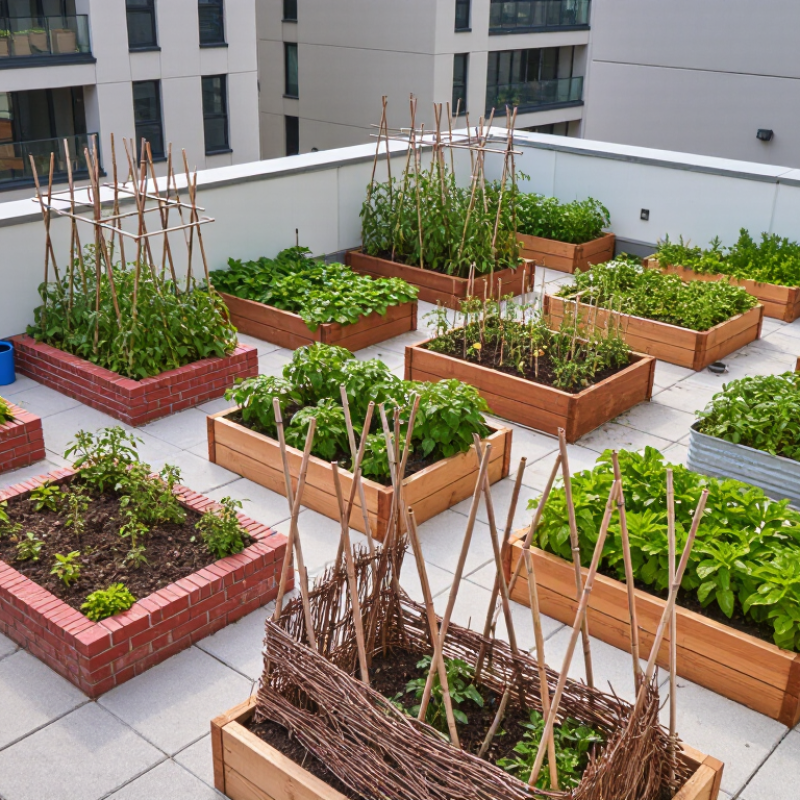
A budget-friendly raised bed in China should begin with a clear price ceiling. For a 1.2-by-0.9-meter bed, I would set 450 to 700 RMB, excluding labor and power tools. This range allows practical choices without sacrificing basic durability. Prices vary.
Local untreated pine may cost about 35 to 70 RMB per meter, depending on thickness and moisture content. Thicker boards resist bending, but they increase the total quickly. Avoid damp, cracked timber, even when it looks cheap. Use outdoor-grade screws, corner brackets, and washers. Together, basic hardware may cost 50 to 100 RMB. Galvanized fasteners are usually a safer choice for humid gardens.
Soil often becomes the hidden expense. A 30-centimeter-deep bed needs roughly 0.32 cubic meters of growing medium. Bagged soil can cost 40 to 90 RMB per 50 liters, while screened bulk soil may cost less locally. Ask about pH, drainage, and compost content before buying. My first estimate ignored delivery fees and wasted soil. That mistake added nearly 100 RMB. Leave room for transport, replacement boards, and a simple gravel layer. Prices vary by city, season, and order size. Comparing three nearby suppliers gives a more reliable budget than copying an online list.
Indicative mainland China material benchmarks in RMB; excludes delivery, labor, tools, and optional irrigation.
| Rank | Build Concept | External Size (L × W × H) |
Estimated Soil Volume (m³) |
Timber Needed (linear m) |
Timber Cost (RMB) |
Soil Mix Cost (RMB) |
Hardware Cost (RMB) |
Estimated Total (RMB) |
Best Use |
|---|---|---|---|---|---|---|---|---|---|
| 1 | Compact single box | 1.2 × 0.6 × 0.30 m | 0.22 | 3.6 | 85 | 75 | 30 | 190 | Balconies, patios, and first-time gardeners |
| 2 | Standard family planter | 1.8 × 0.9 × 0.30 m | 0.49 | 5.4 | 130 | 170 | 45 | 345 | Leafy greens, herbs, and compact vegetables |
| 3 | Large rectangular bed | 2.4 × 1.2 × 0.30 m | 0.86 | 7.2 | 175 | 300 | 60 | 535 | High-yield seasonal vegetable production |
| 4 | Deep root-friendly box | 1.5 × 1.0 × 0.45 m | 0.68 | 5.0 | 165 | 240 | 50 | 455 | Carrots, beets, peppers, and tomatoes |
| 5 | Medium deep bed with corner braces | 1.8 × 1.2 × 0.45 m | 0.97 | 6.0 | 220 | 340 | 65 | 625 | Shared household garden with mixed crops |
| 6 | U-shaped access bed | 2.4 × 1.8 × 0.30 m | 1.12 | 8.4 | 260 | 390 | 90 | 740 | Easy-reach gardens and accessible gardening |
| 7 | Two-level tiered planter | 1.8 × 1.2 × 0.30 m | 0.72 | 7.2 | 230 | 250 | 70 | 550 | Small yards where vertical space matters |
| 8 | Lined timber bed for wet climates | 1.5 × 0.8 × 0.35 m | 0.39 | 4.8 | 150 | 140 | 80 | 370 | Rainy regions; includes a basic inner liner allowance |
| 9 | Narrow balcony trough | 1.2 × 0.4 × 0.35 m | 0.17 | 3.2 | 80 | 60 | 40 | 180 | Herbs, salad greens, and lightweight crops |
| 10 | Extra-deep production bed | 2.4 × 1.2 × 0.45 m | 1.30 | 8.4 | 280 | 455 | 80 | 815 | Long-season vegetables and deep-rooted crops |
Set aside about 450–700 RMB, excluding labor and power tools. Leave extra money for delivery, replacement boards, and drainage gravel. Prices vary by city and season.
Choose fresh, untreated timber with no paint, oil, or chemical odor. Avoid damp, cracked, splintered boards and unknown reclaimed wood. Thicker boards bend less, but they cost more.
Use outdoor-grade screws, corner brackets, and washers. Galvanized fasteners usually handle humid gardens better. Basic hardware may cost 50–100 RMB.
A 1.2-by-0.9-meter bed, 30 centimeters deep, needs roughly 0.32 cubic meters of growing medium.
Compare at least three nearby suppliers. Ask about pH, drainage, compost content, and delivery charges. Bulk soil may cost less than bags. I once ignored delivery fees and wasted soil, adding nearly 100 RMB.
Try reclaimed untreated planks, bamboo, bricks, concrete blocks, fieldstone, roof tiles, or wire-filled stone baskets. Stepped beds suit sloped ground. Narrow timber beds can fit balconies. Keep drainage openings clear.
About 15 centimeters may suit shallow greens. Many vegetables perform better in 20–30 centimeters of soil. Carrots and tomatoes need greater depth.
Avoid painted wood, oily boards, old railway sleepers, unknown pallets, and chemically treated timber. Check the material history before planting edible crops. I once chose the cheapest boards and later regretted it.
Add drainage gaps and keep runoff away from walls. Use mulch to slow evaporation. Test questionable soil and water before planting. Cheap materials still require careful maintenance.
This guide explores China’s top 10 budget-friendly raised garden bed builds, beginning with practical cost criteria for locally available timber, soil, fasteners, and drainage materials. It explains how to select safe materials by considering relevant GB standards and general university extension guidance, while avoiding unnecessary treatments or costly components. The designs range from reclaimed wood and simple timber frames to recycled containers, woven borders, and low-cost masonry options.
Readers will also learn How to build a budget-friendly raised garden bed by comparing construction methods, soil depth, drainage, maintenance needs, and expected growing performance. Using a 15–30 cm soil-depth benchmark, the article evaluates each design for durability, labor requirements, total setup cost, and estimated cost per growing square meter. The final ranking helps gardeners choose a practical bed that matches their space, available materials, budget, and long-term gardening goals.

 Snax Garden